Showing posts with label Science. Show all posts

Tuesday, June 9, 2009

Eeyore's News and View

So much for free speech (i know it is not that simple)but so much for free speech

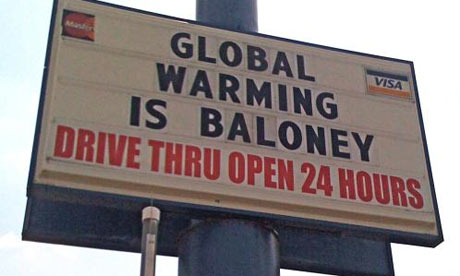
'Global warming is baloney' signs put the heat on Burger King
A row between the fast food giant Burger King and one of its major franchise owners has erupted over roadside signs proclaiming "global warming is baloney".
The franchisee, a Memphis-based company called the Mirabile Investment Corporation (MIC) that owns more than 40 Burger Kings across Tennessee, Arkansas and Mississippi, has described Burger King as acting "kinda like cockroaches" over the controversy. MIC says it does not believe Burger King has the authority to make it take the signs down.
The dispute began to sizzle last week, when a local newspaper reporter in Memphis, Tennessee, noticed the signs outside two restaurants in the city and contacted the corporation to establish if the message represented its official viewpoint. Burger King's headquarters in Miami said it did not, adding that it had ordered MIC to take the signs down.
But a few days later readers of the Memphis paper said they had seen about a dozen Burger King restaurants across the state displaying the signs and that some had yet to be taken down. Media attempts to contact MIC to establish why it was taking an apparently defiant stance were rebuffed, but the Guardian managed to grill MIC's marketing president, John McNelis.
"I would think [Burger King] would run from any form of controversy kinda like cockroaches when the lights get turned on," said Mr McNelis. "I'm not aware of any direction that they gave the franchisee and I don't think they have the authority to do it."
McNelis added: "The [restaurant] management team can put the message up there if they want to. It is private property and here in the US we do have some rights. Notwithstanding a franchise agreement, I could load a Brinks vehicle with [rights] I've got so many of them. By the time the Burger King lawyers work out how to make that stick we'd be in the year 2020."
He continued: "Burger King can bluster all they want about what they can tell the franchisee to do, but we have free-speech rights in this country so I don't think there's any concerns."
The Guardian sent a transcript of the interview to Susan Robison, Burger King's vice-president of corporate communications.
She responded: "The statement that was posted on several restaurants' reader boards in the Memphis area, and the view expressed by the franchisee on this issue does not reflect Burger King Corp's opinion … BKC has guidelines for signage used by franchisees [which] were not followed. We have asked the franchisee to remove the signage and have been told that the franchisee will comply."
http://www.guardian.co.uk/world/2009/jun/05/burger-king-global-warming-us

NRA gun case appeal heads to high court
WASHINGTON — One year after the Supreme Court ruled that the Second Amendment protects an individual right to keep handguns, the justices have before them a new test of that right.
The National Rifle Association has appealed a ruling from a U.S. appeals court in Chicago that said the right to bear arms cannot be invoked by gun owners challenging state and local firearm regulations. It said the high court's groundbreaking decision last term in a case from Washington, D.C., allows the Second Amendment to cover only regulations by the federal government — at least until the high court weighs in again.
If the justices decide to take up the appeal, it would probably be heard next fall by a bench that could include Supreme Court nominee Sonia Sotomayor, who is now on a federal appeals court in New York. She was part of a court panel in January that similarly held that the 2008 gun decision did not apply to state regulations.
A U.S. appeals court in San Francisco, however, ruled this year that the Second Amendment indeed covers state gun restrictions.
"Because of the split in opinions (on the breadth of the 2008 ruling), it seems likely that the court would take it," says Daniel Vice, a lawyer with the Brady Center to Prevent Gun Violence. He says a ruling could affect gun laws nationwide.
The June 2008 decision, decided by a 5-4 vote, said for the first time that the Second Amendment protects an individual right to keep handguns at home for self-protection. A 1939 high court decision had led lower courts and many legal analysts to believe the Second Amendment covered firearm rights only for state militias such as National Guard units.
The new decision in National Rifle Association v. Chicago by the U.S. Court of Appeals for the 7th Circuit in Chicago, written by conservative Ronald Reagan appointee Frank Easterbrook, echoes the closely scrutinized decision from a three-judge panel of the U.S. appeals court for the 2nd Circuit that included Sotomayor.
She joined an opinion that rejected a challenge to a New York ban on certain weapons used in martial arts and emphasized that the high court has never specifically ruled that the Second Amendment can be applied to state regulations. That 2nd Circuit decision, Maloney v. Cuomo, provoked some gun rights groups to protest Sotomayor's nomination. The Virginia-based Gun Owners of America called her "an anti-gun radical."
Last Tuesday's decision by the 7th Circuit undercuts criticism that the Sotomayor panel decision was extreme. As Easterbrook wrote, specifically agreeing with the 2nd Circuit, the Supreme Court said in the 2008 case involving a District of Columbia handgun ban that it was not deciding whether the Second Amendment covered state or local regulations.
Justice Antonin Scalia, who authored the high court decision, noted that the case arose from the federal enclave of Washington, D.C., and that past cases said the Second Amendment covers only the federal government. With a new case from a state or municipality, the court could extend the reach of the Second Amendment.
Until then, Easterbrook wrote in the case involving handgun bans in Chicago and Oak Park, an appeals court may not "strike off on its own." He said that would undermine the uniformity of the nation's laws.
The NRA's Stephen Halbrook, representing Chicago and Oak Park residents who want to keep handguns at home, urged the justices to take up the 7th Circuit case to resolve the reach of last term's ruling.
Halbrook said the right to guns "allows one to protect life itself."
http://www.usatoday.com/news/washington/judicial/2009-06-07-court-guns_N.htm

The World is seems is interested in "privacy issues and civil liberties"
Swedish Pirate Party enters EU parliament: partial results
A Swedish party that wants to legalise Internet filesharing and beef up web privacy scored a big victory Sunday by winning a European parliament seat, results showed.
The Pirate Party won 7.1 percent of votes, taking one of Sweden's 18 seats in the European parliament, with ballots in 5,659 constituencies out of 5,664 counted.
"Privacy issues and civil liberties are important to people and they demonstrated that clearly when they voted today," one of the party's candidates, Anna Troberg, told Swedish television on Sunday.
The party was founded in January 2006 and quickly attracted members angered by controversial laws adopted in Sweden that criminalised filesharing and authorised monitoring of emails.
Its membership shot up after a Stockholm court on April 17 sentenced four Swedes to a year in jail for running one of the world's biggest filesharing sites, The Pirate Bay.
Prime Minister Fredrik Reinfeldt's conservative Moderates won 18.8 percent of votes and four seats, close to its score in the European election in 2004 but down sharply from the 26.1 percent it won in Sweden's 2006 general election.
Coming little more than a year ahead of Sweden's next general election in September 2010, political analyst Mats Knutson called the result a "formidable cold shower" for Reinfeldt, speaking on public television SVT.
The opposition Social Democrats, traditionally Sweden's biggest party, won 24.6 percent, also close to their result in 2004 and maintaining their five seats in the EU parliament.
The Greens scored a strong rise in support, and were credited with 10.8 percent of votes compared to 6.0 percent in 2004 and doubled their seats to two.
The formerly communist Left party saw its support drop from 12.8 percent in 2004 to 5.6 percent and one seat, a drop of one.
The far-right Sweden Democrats, which are not represented in Sweden's parliament, meanwhile tripled their score but not enough to win a seat in parliament.
Their support rose from 1.1 percent in 2004 -- and 2.9 percent in the 2006 general election -- to 3.3 percent.
Voter turnout in Sweden was 43.7 percent, higher than the 37.1 percent in the 2004 election, election officials said.
http://www.breitbart.com/article.php?id=CNG.243153c6a091a3b942a75077729e8c92.941&show_article=1

It were just about safety the police would have no problem with it, but the cameras are money makers and they need money now because they can not or will not make cuts in their budgets.
Software warns of speed camera locations
June 8, 2009 - 5:45am
WASHINGTON - Rather than obey the speed limit, some drivers are installing software that warns them to slow down when they are near a speed camera.
One software company that is cashing in on the trend to add more speed cameras across the nation is PhantomAlert.
PhantomAlert uses cars' Global Positioning System devices to track the location of speed and red light cameras. For a monthly, yearly or "lifetime" fee, subscribers get unlimited access to the service, including updates as more cameras are added.
Maurice Nelson, who directs Montgomery County's camera-enforcement program, says the service raises awareness of speed cameras. But Nelson tells The Washington Post that he hopes PhantomAlert doesn't send the message that drivers can speed until they are alerted.
Because compliance with the speed laws is the rationale for placing cameras in the first place, reaction from law enforcement is mixed. One thing Nelson objects to is an option that tells drivers the locations of sobriety checkpoints.
PhantomAlert is owned by Joseph Scott, whose previous projects include PhotoBlocker, a reflective spray-on substance intended to foil speed cameras, and PhotoShield, a clear license plate cover with the same purpose.
http://wtop.com/?nid=30&sid=1691544

Here is a great reason for Captiol Punishment
West Bank teen arrested in rape and murder of 8-month-old
A 17-year-old Terrytown man was arrested on charges of aggravated rape and first-degree murder of an 8-month-old child Saturday afternoon, the Jefferson Parish Sheriff's Office said.
Arnold T. Ross, of 136 Friedrichs Road in Terrytown, was booked into the Jefferson Parish Correctional Facility. No bond is available on the first-degree murder charge.
Ross was arrested after officers responded to a call of an unresponsive infant at 1656 Gary Court, Apt. B, near Gretna.
The infant, Da-Von Lonzo, was taken to Ochsner Westbank where he was pronounced dead shortly after arrival, according to a release issued by Col. John Fortunato, a spokesman for the sheriff's office.
The death was initially unclassified, but the Jefferson Parish coroner's office later reported it as a homicide after an autopsy of the child's body revealed multiple fractures consistent with a beating and tears in the anus.
Ross, who said he was the boyfriend of the infant's mother, initially told detectives that the baby fell down the stairs while he was babysitting, Fortunato said. But a neighbor reported hearing loud noises coming from the apartment, and investigators noted inconsistencies in Ross's account.
Ross later admitted that he beat the infant repeatedly when he would not stop crying, Fortunato said. When the child began to defecate on himself, Ross said he tried to clean it up, causing the tears, according to the release.
Ross has a record of previous arrests for possession of crack cocaine and marijuana, obscenity, battery on a correctional officer, three counts of battery on a teacher, three counts of theft, illegal carrying of a weapon and assault.

http://www.nola.com/news/index.ssf/2009/06/gretna_man_arrested_in_rape_an.html

Saturday, May 16, 2009

Eeyore's News and view

Missy – A Vignette

“Mother?” asked nine-year-old Missy Banks, “What if my new teacher doesn’t like me?”

Helen Banks was getting Missy ready for the first day of fourth grade. “I’m sure she’ll like you, Missy. What’s not to like?” She hugged her daughter and then put the remaining items into Missy’s pretty pink day pack. The pack matched her sturdy athletic shoes.

“Oh, Mother! You’re so funny!” The laughter faded, and Missy asked her mother another question. “When should I give the teacher my note?”

Helen turned Missy around to face her and put her hands on Missy’s shoulders, looking into her soft brown eyes. “Mrs. Wilson will be very busy this morning. You can wait until I come to pick you up and we’ll show her together. How’s that?”

Missy cheered up. “Teachers don’t like your and Daddy’s letters, Mother. I’m glad you’re going to be with me when I give it to her.”

Again Helen hugged Missy. She couldn’t be more proud of Missy. She hadn’t assumed Helen would giver her teacher the letter. She was prepared to do it herself, but having her mother there made her feel better.

With a last check of Missy’s new school uniform, Helen got her keys from the rack by the back door and said. “Okay, Sweetie. Time to go.”

Missy followed resolutely out to the Subaru wagon. “First days at school are hard.” she told her mother.

Both were silent as Helen headed for the middle school. But Missy saw her friend Julie being dropped off, and hurried to join her, with just a quick good-bye to her mother.

Helen sighed and watched the two girls go into the school, hand in hand. She looked over and saw the two security guards the school had hired and shook her head. Armed guards at school. What was the world coming to?

“Home school, next year, for sure,” Helen said, blinking back tears. They would be in a position to do that by the next school year. Her job the last three years had put them over the top on getting debt free. Jack’s income would keep them going nicely, meeting day-to-day needs, putting money away in life annuities for retirement, and improving their prep stance.

With Missy never completely out of her mind, Helen went about her chores for the day. She got everything done in plenty of time to meet with Missy’s teacher and then take Missy home.

Missy was right about the teacher not liking the note that Missy handed Miss Wilson, with her mother standing behind her after the other children left the classroom.

“These are my instructions if something bad happens at school, Miss Wilson.”

Amy Wilson read the computer printed letter and noted that Both Helen and Joe Banks had signed it.

“This is ridiculous,” Miss Wilson said, upon finishing the note. “School policy…”

“I’ve had the same letter put in Missy’s records in the office. If something happens, and Missy is harmed in any way, because these instructions are disregarded, there will be repercussions.”

“I don’t respond to threats well, Mrs. Banks,” Miss Wilson said. “School policy will be followed. Not the rantings of some hysterical parent.”

Missy had edged around behind her mother slightly as both women’s voices rose slightly.

“It’s not a threat. Just be aware that Missy is very well educated when it comes to possible problems here at school and in the community.”

“She will follow the rules the school board has laid out or she will be suspended. Now, Mrs. Banks, I suggest you take your letter, your child, and leave. Before there are repercussions. I will call on one of the security staff if you don’t leave immediately.”

Helen took the letter in one hand and Missy’s hand in the other and left the classroom and then the building. When they got to the Subaru, Helen looked her precious daughter in the eyes. “Are you all right, Missy?”

There were tears in her eyes, but Missy nodded. “Yes, Mommy,” she said, slipping back to her younger age use of ‘Mommy’ rather than the more grown up Mother she’d been using for the last few months.

“Don’t cry, honey. This isn’t your fault. And now, I’m going to tell you something very important. Okay?”

Missy nodded. “Yes, Mother.” She wiped her eyes and looked at her mother expectantly. “The Principal and Vice-Principle in the office and Miss Wilson all have read the letter. From now on, you don’t have to worry about it. Just follow the rules. If something really bad ever happens, like we’ve talked about, I want you to do whatever your father and I have taught you and ignore the rules.”

“I don’t like not following rules, Mother. It gets me in trouble.”

A slight smile curved Helen’s lips. “Yes, I understand that. So that’s why I want you to follow them. And if Miss Wilson asks you about this in the next few days, you tell her that I told you to follow the rules. You need not mention that you have other instructions if something bad happens. Can you remember to do that?”

“Yes, Mother.” Missy’s voice showed a bit of exasperation at her mother’s doubt that she could remember something that easy.

“Yes, of course you can. And how was Julie?” Helen asked, leaving the subject of following the security rules of the school behind. For now.

Eagerly Missy explained everything that had happened, including renewing acquaintances with her school year best friend, Julie Howards.


That evening, as Helen and her husband got ready for bed, Helen recounted what had happened at school.

“About what we expected,” Joe replied. “Is Missy going to be okay with the double standard?”

I think so,” Helen replied. “She’s a smart cookie. And with the emergency training we involve her in, I think she can differentiate between the normal goings on, and something that requires her to make her own judgments.”

“Let’s just hope she doesn’t ever have to,” Joe replied.


Keeping one more secret wasn’t hard for Missy. She was used to it. Ever since she was little, she’d been instructed not to tell people certain things. Such as the shelter in the basement, and all the food they have in it. And never to tell anyone about the guns her mother and father had. Or about some of the things in her backpack in the special bag. Or the fact that the pack had a Kevlar bullet resistant back panel.

Missy had her very own Get-Home-Bag that she carried in her back-pack. And knew how to use everything it contained.

First there was the laminated ID with her picture, name, home address and telephone number, alternate address and telephone number of her Aunt Jackie and Uncle Jim, with their pictures and names.

Another laminated card, again with her home address and telephone number and parents’ cell phone numbers. There was a list of safe houses if her parents weren’t available, with names, addresses and telephone numbers. It also included the telephone number of a taxi service that Joe and Helen trusted.

A city map with home and relatives’ addresses marked, along with the list of safe houses.

A small coin purse contained a ten dollar bill, a five dollar bill, and five ones, plus coins. The bills were primarily for paying for a taxi. Included was a signed note that offered a reward to get Missy safely to one of the addresses on the laminated cards if she asked for a cab. The change was primarily for vending machines or a pay telephone.

The school didn’t allow children to bring cell phones or she would have a prepaid one. In addition to the money, the packet contained a telephone card so Missy could make calls on any payphone, or regular telephone. She used it at least once a month under supervision so she could remember how. Usually she called her grandmother to say hello.

Two juice boxes, packet of trail mix, one of jerky, and some hard candies provided a little nutrition and much comfort. Two one-liter bottles of water covered hydration needs. A windup flashlight provided light if needed. A space blanket and disposable poncho provided shelter and warmth. A change of underwear, knit cap, and pair of warm gloves in a vacuum sealed bag for cleanliness and compactness was included. A camper’s pack of toilet tissue, individual moist towelettes, a one-ounce bottle of Purell for sanitation if regular bathroom facilities weren’t available.

A couple of band-aids and two larger patch bandages were the only first aid items. Over the counter medicines weren’t permitted by the school. A packet of tissues was included in case of runny noses.

There was a shrill whistle and a small mirror for signaling, and a dust mask and swimming goggles for her to wear if there were dust, smoke, or fumes involved in the emergency.

Like cell phones, lighters and pocket knives were banned from the school, so Missy had to do without those, even though she knew how to use them safely.

Missy had memorized three code words and their uses with help from her mother. One word was used to indicate it was her parents’ instructions, by them or trusted family and friends to give or receive information or pick Missy up, and a second word that meant for her to keep doing what she was doing, primarily meaning stay where she was. A third word that meant Missy was supposed to follow her Get Home Now plan.

Miss Wilson kept a close eye on Missy for a while, but the intelligent, vivacious little girl did nothing out of the ordinary and the letter was soon out of Miss Wilson’s mind. Missy was just another of her students.


That was until three days before Christmas break. Everyone was excited about the upcoming break. The Banks family had plans to spend the time at Helen’s mother’s place in the country.


Helen dropped Missy off, as usual. Missy ran to join the waiting Julie. Helen’s eyes were drawn to one of the security guards. He was at the fence near the swing set, talking to a man in blue jeans and a leather jacket.

Her sense of danger tingled, just slightly, at the sight. There was no tangible reason to be concerned. Especially as the man in the leather jacket turned and walked away. Helen put it out of her mind, thinking about the grocery run she was making next. But that little tingle was still there.

Definitely her mother’s daughter, and well educated by both her parents to be observant of her surroundings at all times, noticed the same thing Helen had. The security guard talking to a stranger. If that had been a student, they would be on their way to detention. But the stranger left, and the guard, George, headed back to where he usually stood during the morning arrival of the students.

The security man George wasn’t one of the students’ favorite people. He was surly and unpleasant. Mike, on the other hand, while maintaining a certain professional distance, would speak pleasantly, nod, and smile. He was an okay guy in the eyes of most of the students and teachers, too.

Missy also noted her teacher when Miss Wilson greeted Missy and Julie as they entered the classroom. She looked drawn, and not very happy. “Are you sick, Miss Wilson?” Missy asked, stopping as Julie continued to her desk.

A wan smile curved Amy Wilson’s lips. She’d become fond of Missy. She was an excellent student. All that trouble over the letter had been a tempest in a tea cup. “No, Missy. I’m not sick, though I do not feel very well. Nothing to concern you.”

“Yes, Miss Wilson. I hope you feel better.”

“I will, I’m sure. Now go ahead and take your seat and get your English book out.”

“Yes, Ma’am.” Missy hurried over to her desk and did as Miss Wilson said, tucking the back pack into the tray under the seat of the combined seat/desk unit. She chatted with Julie for a moment, but the bell rang and everyone in the class went quiet and waited for Miss Wilson to start the class.

Things progressed normally that morning. Missy had forgotten about the man George had been talking to until she saw him outside the schoolyard gate. Mike was nowhere in sight. George started over to the gate and Missy expected George to make him leave. Instead, the two men talked for a moment and Missy saw George point toward where Miss Wilson was standing, talking to Missy’s former third grade teacher, Angela Montague.

It just didn’t seem right, and Missy, taking Julie’s hand to bring her along, ran over to the two teachers monitoring the afternoon recess. “Miss Wilson! Someone is at the gate and George isn’t making them leave.”

“That’s Officer George, Missy,” Angela said, her attention on Missy rather than the gate. But Amy Wilson looked over at the gate. Missy saw her give a little start.

“I’ll go handle this,” Miss Wilson said, striding firmly away, toward the gate.

“You children go play,” Angela said, intending to follow Amy. With the way things were now, the instructions were to always have two people when someone not with the school was on the premises.

Amy drew up short when the man in the leather jacket slapped Amy as soon as she stepped up to him and George. George made no move to stop it, as the man grabbed Amy.

“Everyone! Into the building! Now!” Angela began urging the students inside, with the help of the other teacher on recess duty.

“Where is Mike?” yelled the other teacher, looking around even as he urged the children inside.

Having shot her personal .22 pistol and rifle many times when at the range with her parents, Missy knew what a gunshot sounded like. The sound was much louder without her hearing protection. That just added a bit of impetus to her moves as she ran for the building.

Angela was screaming at the principle, who had come out of the school offices at all the commotion of children running into the building. “Lock down! Lock down! There’s a man with a gun!”

Mr. Chambers hurried back to the office and the lock down siren began to sound. The students were entering their respective classrooms and Julie was about to enter Miss Wilson’s. Missy made a quick decision. Her parents had stressed to her not to be caught with no way out in case of trouble. They were adamantly against the lock down policy of the school.

Missy grabbed Julie’s hand and tugged her away from the door to the classroom. She led Julie to the girls’ bathroom at the end of the hall.

It suddenly got quiet, other than the sound of the siren, as Missy held the door of the bathroom open just slightly and watched the hallway. She jerked back, but then quickly put her eye to the narrow slot of the door opening when George and the man in the leather jacket dragged Miss Wilson into the building and took her into her classroom.

“Come on, Julie! We need to get away!”

“No! We’re in lockdown! We’re supposed to be in our classroom! I’m scared, Missy!”

“So am I, Julie. But we have to be calm. Not panic. My mom and dad tell that to me all the time.”

There were tears in Julie’s eyes. “And I wet my underpants!”

“That’s okay, Julie,” Missy said. Julie was as upset about her accident as she was the rest of the situation.

“Look,” Missy added, letting the bathroom door close. “I have an extra pair. You can wear them.”

“Really?” Julie asked through her sniffles.

Missy nodded and took off her back pack. It took only a moment to get the zip-lock bag out and open. Julie changed in a stall and came back out a bit calmer. “We should go to the room, Missy,” Julie said. “We’ll get in trouble if we don’t.”

The building siren suddenly cut off. But through the crack left when Missy eased open the bathroom door slightly again, the two girls could hear police and fire sirens approaching from the distance.

George came out of Miss Wilson’s classroom. Missy saw that he had his gun out. She eased the door a bit more closed and continued to watch with one eye. She shivered when George opened the front door of the school just slightly and yelled out, we’ll start killing kids in an hour if you don’t bring us a million dollars and a helicopter! You try to rush us and we’ll kill as many kids as we can before you can stop us!”

George quickly backed away from the doors and leaned against a wall, watching the outside activity as not only police and fire vehicles started showing up at the gate, but several personal vehicles, too. The word had already made the rounds.

Suddenly, the man in the leather jacket dragged Miss Wilson out of the classroom. She was whimpering and crying. “There’s two missing, you idiot!” the man half screamed at George.

“Two! But who? Everyone is supposed to go to their classroom when the siren sounds!”

“I don’t care about what they are supposed to do. Two didn’t, in just this classroom. There could be more. Find them. And kill them.”

“Who are they?” George asked Miss Wilson.

She didn’t answer and George slapped her. Missy drew a sharp breath.

Crying, Miss Wilson whispered, “Missy Banks and Julie Howard.”

“Oh, I’m going to have fun with those two before I kill them,” George said. It was barely loud enough for Missy to hear, but she did. Julie didn’t and Missy didn’t tell her what George had said. Missy was old enough to understand what George meant and she was determined that neither she nor Julie would suffer that fate, much less die.

The leather jacket man took Miss Wilson back into the classroom, and George went into the school offices. Suddenly the PA system squealed and George’s voice came over it. “I’m gonna get you two. You know who you are. Come on out and everything will be fine.”

Julie looked at Missy, but Missy just grabbed Julie’s hand in one of hers and pushed open the bathroom door with the other. “Come on! Run!” Missy hissed. She was leading the way toward the outside entrance nearest the bathroom. They were through it and outside.

Missy had a destination in mind. She quickly led Julie to a spot behind the big compost bin the school maintenance people used to compost the grass clippings. Missy looked up with a frown. It had been threatening snow all day. It started coming down hard and the wind picked up.

“I’m cold, Missy!” Julie said after a few moments. “We have to go back inside! We’ll freeze.”

Missy wasn’t feeling the cold. She still had on her jacket from being out for recess. Julie had taken hers off when she changed and hadn’t put it back on. Her training coming back to her, Missy took off her back pack and took out the watch cap, gloves, emergency poncho and the space blanket.

“Here, Julie. Put these on,” Missy said, giving Julie the poncho first. When she had the items on, Missy hugged her close and wrapped the space blanket around them both. Missy kept her head clear so she could hear and watch.

They were in a cul-de-sac, hidden from sight from the school, but also from the police that Missy assumed were out there trying to help. The way out of the cul-de-sac would take them past Miss Wilson’s room’s windows. They couldn’t even crouch down and go under the level of the windows. The windows were almost full height as part of the solar heating system.

Again the PA system sounded. George was not a happy camper. Missy hugged Julie close when he began to explain what he was going to do to them when he found them. Julie started crying again.

Missy dug out juice and the trail mix from her backpack and urged Julie to eat and drink something to calm her down. Missy kept taking peeks around the corner of the compost bin. She saw George at the doors once and jerked her head back. She was ready to explode outward and run if George came out. But when she looked a few moments later, George was gone.

To Julie it seemed like they were there forever, but Missy had a good sense of time and knew they’d only been outside for perhaps twenty minutes. She relaxed just slightly.

When George came around the opposite corner of the compost bin, he caught Missy off guard, though he was actually the most startled. He wasn’t expecting them to be there. He thought they might be in the utility shed where the mowers were.

Missy had thought about that, but didn’t want to be trapped inside another place. She wanted space to run.

When she saw him, Julie screamed and George started. Missy lunged up and shoved George. He went down hard. Missy wasted no time. Grabbing Julie’s hand again, she jerked her up and began running toward the opening of the cul-de-sac. “Run, Julie! Run!” Missy yelled, releasing her hand so they could both pump their arms and run faster.

Missy was the faster of the two girls, but slowed down to let Julie take the lead. She didn’t realize what she heard first, but the sound of the gunshot came immediately after the whistle of the bullet that sailed past Missy’s right ear. She knew that George was shooting at them.

A bullet chipped the brick at the corner of the building as Missy turned the corner. Missy’s heart leaped when she saw the police and firemen and there was her mother right there by the gate, behind the police warning tape.

She saw several policemen raise their weapons, but didn’t hear the shots as she felt a great pain in her back and went tumbling. The last thought she had was, “George shot me!”

It was several minutes before she came to. She immediately recognized the fact that she was in her mother’s arms. “It hurts, Mommy!” Missy cried.

“I know, Sweetie, I know. But you’re okay. The paramedic said the Kevlar panel stopped the bullet. But you have severe blunt trauma. We have to take you to the hospital, just in case there are complications.”

“Is Julie okay? George was shooting at us.”

“She’s fine. Her father has her over by their car. Come on. Let me help you onto the ambulance stretcher. The police shot him. And Miss Wilson’s boyfriend gave up. He’ll be going away for a long time. He really hurt her and some of the kids. They found Mike tied up in the furnace room.”

“Owie, owie, owie!” Missy couldn’t help it. Even as gentle as the paramedics and her mother were, it hurt being picked up and put on the stretcher.

Just as they started to put the stretcher into the ambulance, Missy saw her father. He had tears in his eyes. “Baby, are you all right?” he asked as the paramedics paused.

“I’m okay, Daddy. It hurts. It really hurts. But Momma says I’ll be okay. I’m glad you gave me the back pack, Daddy. It came in really handy.”

They couldn’t help it. Helen and Jack Banks both had to laugh. Through their tears, but they laughed. Their baby was going to be okay.


End ********

Copyright 2009
Jerry D Young
http://frc4u.org/phpbb/index.php?action=articles;sa=view;article=56

They were pushing for an alternative currency a while back it looks like they had planned for this. They wanted everyone to make the argument why going to a metal (like copper or other) was not a good idea, so they same arguments could not be used against them when their currency take precedence. Just my ramblings.
China's yuan 'set to usurp US dollar' as world's reserve currency
The Chinese yuan is preparing to overtake the US dollar as the world's reserve currency, economist Nouriel Roubini has warned.
Professor Roubini, of New York University's Stern business school, believes that while such a major change is some way off, the Chinese government is laying the ground for the yuan's ascendance.
Known as "Dr Doom" for his negative stance, Prof Roubini argues that China is better placed than the US to provide a reserve currency for the 21st century because it has a large current account surplus, focused government and few of the economic worries the US faces.
China will soon want to see the yuan included in the International Monetary Fund's special drawing rights "basket", he warns, as well as seeing it "used as a means of payment in bilateral trade."
Prof Roubini's warning followed the US government's latest economic data that showed producer prices in April experienced their biggest year-on-year drop since 1950, falling 3.7pc.
The number of Americans claiming unemployment benefit for the first time rose by 32,000 to 637,000 in the week to May 9. The increase meant the total number of people claiming benefits stood at to 6.56m, a record high for the 15th consecutive week in a row.
But neither the gloomy data, nor Prof Roubini's verdict on the greenback's future, held back the markets. The Dow Jones traded up 59.89 at 8344.78 in lunchtime trading.
http://www.telegraph.co.uk/finance/financetopics/financialcrisis/5325805/Chinas-yuan-set-to-usurp-US-

Environmental alarms raised over consumer electronics
Charge your iPod, kill a polar bear?
The choice might not be quite that stark, but an energy watchdog is alarmed about the threat to the environment from the soaring electricity needs of gadgets like MP3 players, mobile phones and flat screen TVs.
In a report Wednesday, the Paris-based International Energy Agency estimates new electronic gadgets will triple their energy consumption by 2030 to 1,700 terawatt hours, the equivalent of today's home electricity consumption of the United States and Japan combined.
The world would have to build around 200 new nuclear power plants just to power all the TVs, iPods, PCs and other home electronics expected to be plugged in by 2030, when the global electric bill to power them will rise to $200 billion a year, the IEA said.
Consumer electronics is "the fastest growing area and it's the area with the least amount of policies in place" to control energy efficiency, said Paul Waide, a senior policy analyst at the IEA.
Electronic gadgets already account for about 15 percent of household electric consumption, a share that is rising rapidly as the number of these gadgets multiplies. Last year, the world spent $80 billion on electricity to power all these household electronics, the IEA said.
Most of the increase in consumer electronics will be in developing countries, where economic growth is fastest and ownership rates of gadgets is the lowest, Waide said.
"This will jeopardize efforts to increase energy security and reduce the emission of greenhouse gases" blamed for global warming, the agency said.
Existing technologies could slash gadgets' energy consumption by more than 30 percent at no cost or by more than 50 percent at a small cost, the IEA estimates, meaning total greenhouse gas emissions from households' electronic gadgets could be held stable at around 500 million tons of CO2 per year.
If nothing is done, this figure will double to around 1 billion tons of CO2 per year by 2030, the IEA estimates.
Televisions are one area where much improvement could be made, Waide said.
The IEA estimates the world will soon have 2 billion TVs in use - or an average of 1.3 televisions for every household with electricity. In addition to becoming more numerous, TVs are also getting bigger screens and are being left on for longer each day. The group predicts 5 percent annual increase in energy consumption between 1990 and 2030, just from TVs alone.
Waide said simple measures, such as allowing consumers to regulate the energy consumption of their gadgets according to the features they actually use, should be adopted to counter this growth.
He said governments also need to encourage minimum performance standards and easy-to-read energy labels, so consumers can take energy efficiency into account along with price when buying home electronics
http://seattletimes.nwsource.com/html/nationworld/2009214989_apeugreenergadgets.html

Developments on swine flu worldwide
May 15, 2009 - 2:48am
By The Associated Press
(AP) - Key developments on swine flu outbreaks, according to U.S. Centers for Disease Control and Prevention, World Health Organization and government officials:
_Deaths: Global total of 70 _ 64 in Mexico; four in U.S.; one in Canada and one in Costa Rica. Officials said the Canadian, U.S. and Costa Rican victims also had other medical conditions.
_Confirmed cases: Estimated 6,673 in 35 countries, including at least 2,656 in Mexico; 3,352 in 46 U.S. states and the District of Columbia; and 389 in Canada.
_Arizona officials revealed that a woman in her late 40s died last week of what appears to be complications of the new strain of influenza. The woman had been suffering from a lung condition and lab tests confirmed that the woman was infected with the flu strain.
_In an apparent flare-up of the virus in New York City, three schools were closed and an assistant principal was in critical condition. Four students are ill with swine flu and hundreds of kids were sent home with flu symptoms.
_ Malaysia and Peru each reported its first confirmed case. Peru is the fourth South American nation to confirm the virus' presence, joining Argentina, Brazil and Colombia.
_WHO meets in Geneva to discuss key decisions about making a vaccine. Representatives of European Union and Latin American nations meet in Prague to discuss swine flu and other issues.
_Mexico's confirmed cases jumped by 374 on Thursday, but Health Secretary Jose Angel Cordovaz said that with more confirmations, the virus appears less deadly: the deaths now represent 2.4 percent of confirmed cases.
_WHO estimates that up to 2 billion doses of swine flu vaccine could be produced every year, though the first batches wouldn't be available for four to six months.
_The U.S. Centers for Disease Control and Prevention is currently working on a "seed stock" to make the vaccine, which should be ready in the next couple of weeks.
_A second soldier at Kansas' Fort Riley has been confirmed with being infected with swine flu, the site considered by many historians to be the epicenter of the 1918 flu outbreak.
_Mexico says Peru has agreed to lift its ban on direct flights from Mexico, but three other Latin American nations _ Cuba, Ecuador and Argentina _ still have such measures in place.
_Fidel Castro defends Cuba's decision to suspend direct flights to and from Mexico, saying his island nation is especially vulnerable because it lacks access to medicine and diagnostic equipment.
___
On the Net:
CDC: http://www.cdc.gov/h1n1flu
WHO: http://tinyurl.com/och3eq

Thursday, May 14, 2009

Eeyore's News and View

I get sick of hearing about it every 2 or 4 years in which the military votes don't get counted. For what ever reason, sometimes it seems you can't make it up. Postmarks, well dah they are in the middle of the ocean or desert, they can't get them postmarked. Some people are born stupid and some go to college and law school to get it. They are in harms way and you disenfranchise their vote. What a great country we live in.
Report: One-fourth of overseas votes go uncounted
By JIM ABRAMS
WASHINGTON (AP) - One out of every four ballots requested by military personnel and other Americans living overseas for the 2008 election may have gone uncounted, according to findings being released at a Senate hearing Wednesday.
Sen. Charles Schumer, chairman of the Senate Rules and Administration Committee, said the study, while providing only a snapshot of voting patterns, "is enough to show that the balloting process for service members is clearly in need of an overhaul."
The committee, working with the Congressional Research Service, surveyed election offices in seven states with high numbers of military personnel: California, Florida, North Carolina, Pennsylvania, Texas, Washington and West Virginia.
It said that of 441,000 absentee ballots requested by eligible voters living abroad - mainly active-duty and reserve troops - more than 98,000 were "lost" ballots that were mailed out but never received by election officials. Taking into account 13,500 ballots that were rejected for such reasons as a missing signature or failure to notarize, one-quarter of those requesting a ballot were disenfranchised.
The study found that an additional 11,000 ballots were returned as undeliverable.
Schumer's office said that because a person living abroad must request the absentee ballot and show a clear intention to vote, voter negligence is not thought to be a major factor.
Rather, the New York Democrat said in a statement, there is a chronic problem of military voters being sent a ballot without sufficient time to complete it and send it back. He cited estimates that a ballot can take up to 13 days to reach an overseas voter.
Among the states surveyed, California had 30,000 "lost" votes out of 103,000 ballots mailed out. An additional 3,000 ballots were returned as undeliverable and 4,000 were rejected.
The hearing was to take up possible problems in the Federal Voting Assistance Program, a Pentagon program that handles the election process for military personnel and other overseas voters.
http://apnews.myway.com/article/20090513/D98573FG0.html

Can't make this stuff up. Save the Fire ants from becoming Zombies, Lets spend a billion dollars and figure out how Global Warming has caused this. Might be another starter story for one of Jerry's novels.
Parasitic flies turn fire ants into zombies
By BILL HANNAbillhanna@star-telegram.com
It sounds like something out of science fiction: zombie fire ants. But it’s all too real.
Fire ants wander aimlessly away from the mound.
Eventually their heads fall off, and they die.
The strange part is that researchers at the University of Texas at Austin and Texas A&M’s AgriLife Extension Service say making "zombies" out of fire ants is a good thing.
"It’s a tool — they’re not going to completely wipe out the fire ant, but it’s a way to control their population," said Scott Ludwig, an integrated pest management specialist with the AgriLife Extension Service in Overton, in East Texas.
The tool is the tiny phorid fly, native to a region of South America where the fire ants in Texas originated. Researchers have learned that there are as many as 23 phorid species along with pathogens that attack fire ants to keep their population and movements under control.
So far, four phorid species have been introduced in Texas.
Wandering aimlessly
The flies "dive-bomb" the fire ants and lay eggs. The maggot that hatches inside the ant eats away at the brain, and the ant starts exhibiting what some might say is zombie-like behavior.
"At some point, the ant gets up and starts wandering," said Rob Plowes, a research associate at UT.
The maggot eventually migrates into the ant’s head, but Plowes said he "wouldn’t use the word 'control’ to describe what is happening. There is no brain left in the ant, and the ant just starts wandering aimlessly. This wandering stage goes on for about two weeks."
About a month after the egg is laid, the ant’s head falls off and the fly emerges ready to attack any foraging ants away from the mound and lay eggs.
Plowes said fire ants are "very aware" of these tiny flies, and it only takes a few to cause the ants to modify their behavior.
"Just one or two flies can control movement or above-ground activity," Plowes said. "It’s kind of like a medieval activity where you’re putting a castle under siege."
New colonies
Researchers began introducing phorid species in Texas in 1999. The first species has traveled all the way from Central and South Texas to the Oklahoma border. This year, UT researchers will add colonies south of the Metroplex at farms and ranches from Stephenville to Overton. It is the fourth species introduced in Texas.
Fire ants cost the Texas economy about $1 billion annually by damaging circuit breakers and other electrical equipment, according to a Texas A&M study. They can also threaten young calves.
Determining whether the phorid flies will work in Texas will take time, perhaps as long as a decade.
"These are very slow acting," Plowes said. "It’s more like a cumulative impact measured across a time frame of years. It’s not an immediate silver bullet impact."
The flies, which are USDA–approved, do not attack native ants or species and have been introduced in other Gulf Coast states, Plowes said. Despite initial concerns, farmers and ranchers have been willing to let researchers use their property to establish colonies. At the Texas and Southwestern Cattle Raisers Association in Fort Worth in March, Plowes said they found plenty of volunteers.
Just one or two flies can control movement.  . . . It’s kind of like a medieval activity where you’re putting a castle under siege."
Rob Plowes,
a research associate at UT
http://www.star-telegram.com/804/story/1371092.html

This is a long article but has some very good points about the government (figures lie and lairs figure) And how stupid it is to mandate taking food and using it for fuel (corn) and if you do that it is cheaper and better for the economy to use it to produce electricity then ethanol.
Administration addressing ethanol, climate change
May 5, 2009 - 5:37pm
By H. JOSEF HEBERT
Associated Press Writer
WASHINGTON (AP) - The Obama administration renewed its commitment Tuesday to speed up investments in ethanol and other biofuels while seeking to deflect some environmentalists' claims that huge increases in corn ethanol use will hinder the fight against global warming.
President Barack Obama directed more loan guarantees and economic stimulus money for biofuels research and told the Agriculture Department to find ways to preserve biofuel industry jobs. The recession, as well as lower gasoline prices, has caused some ethanol producers to suffer, including some who have filed for bankruptcy.
Obama said an interagency group also would explore ways to get automakers to produce more cars that run on ethanol and to find ways to make available more ethanol fueling stations. "We must invest in a clean energy economy," Obama said in a statement.
The reassurances to the ethanol industry came as the Environmental Protection Agency made public its initial analysis on what impact the massive expansion of future ethanol use could have on climate change. Rejecting industry and agricultural interests' arguments, it said its rules _ which will take months to develop _ will take into account increased greenhouse gas emissions as more people plant ethanol crops at the expense of forests and other vegetation and land use is influenced worldwide by the demand for biofuels.
When Congress in 2007 required a huge increase in ethanol use _ to as much as 36 billion gallons a year by 2022 _ it also required that ethanol _ whether from corn or cellulosic crops like switchgrass or wood chips _ have less of a "lifecycle" impact on global warming than does gasoline. It set the threshold at 20 percent climate-pollution improvement for corn ethanol and 60 percent for cellulosic ethanol, although ethanol made from facilities already operating would be exempt.
EPA Administrator Lisa Jackson said the analysis shows corn ethanol emitting 16 percent less greenhouse gases than gasoline, even taking into account global future land-use changes.
But that's true in only one of the scenarios the EPA examined; another showed corn ethanol would account for 5 percent more greenhouse gases than gasoline. The scenario Jackson cited assumes future environmental benefits over a period of 100 years will more than pay back the initial increase in greenhouse gases from land-use changes; the second assumes a shorter payback period of 30 years.
Frank O'Donnell, president of the advocacy group Clean Air Watch, said the Obama administration was "walking a tightrope" to try to reconcile the expansion of corn ethanol with its determination to aggressively address climate change. He called the assumption of a 100-year ethanol payback to make up for early greenhouse emission increases "nothing but an accounting trick to make corn ethanol look better."
But environmentalists also praised the EPA for making clear it will take into account worldwide land-use changes in assessing ethanol's climate impacts. "The devil is always in the details, but we're pleased that the EPA proposed rules that would require all global warming pollution from biofuels to be taken into account," said Kate McMahon of Friends of the Earth.
The ethanol industry and farm-state members of Congress had wanted only a comparison of direct emissions, which show ethanol as the clear winner, but welcomed the EPA's promise to examine the issue further.
"There is currently no scientific agreement or certainty to quantify domestically produced ethanol impacts on land-use change," argued Roger Johnson, president of the National Farmers Union, responding to the EPA assessment.
Sen. Tom Harkin, D-Iowa, said he was "skeptical about the science" about the indirect land-use impacts of ethanol on climate change, but that he is pleased the EPA "recognizes the need for a thorough analysis and review of this issue prior to any final decision." Jackson said that as the EPA develops its regulation it will seek out peer-reviewed scientific views on the issue and make its final determination "based on the best science available."
On the Net:
Environmental Protection Agency:
http://www.epa.gov
Renewable Fuels Association: http://www.rfa.org
Agriculture Department: http://www.usda.gov
http://wtop.com/?sid=1667265&nid=116

Swine Flu May Be Human Error; WHO Investigates Claim
May 13 (Bloomberg) -- The World Health Organization is investigating a claim by an Australian researcher that the swine flu virus circling the globe may have been created as a result of human error.
Adrian Gibbs, 75, who collaborated on research that led to the development of Roche Holding AG’s Tamiflu drug, said in an interview that he intends to publish a report suggesting the new strain may have accidentally evolved in eggs scientists use to grow viruses and drugmakers use to make vaccines. Gibbs said he came to his conclusion as part of an effort to trace the virus’s origins by analyzing its genetic blueprint.
“One of the simplest explanations is that it’s a laboratory escape,” Gibbs said in an interview with Bloomberg Television today. “But there are lots of others.”
The World Health Organization received the study last weekend and is reviewing it, Keiji Fukuda, the agency’s assistant director-general of health security and environment, said in an interview May 11. Gibbs, who has studied germ evolution for four decades, is one of the first scientists to analyze the genetic makeup of the virus that was identified three weeks ago in Mexico and threatens to touch off the first flu pandemic since 1968.
A virus that resulted from lab experimentation or vaccine production may indicate a greater need for security, Fukuda said. By pinpointing the source of the virus, scientists also may better understand the microbe’s potential for spreading and causing illness, Gibbs said.
Possible Mistake
“The sooner we get to grips with where it’s come from, the safer things might become,” Gibbs said by phone from Canberra yesterday. “It could be a mistake” that occurred at a vaccine production facility or the virus could have jumped from a pig to another mammal or a bird before reaching humans, he said.
Gibbs and two colleagues analyzed the publicly available sequences of hundreds of amino acids coded by each of the flu virus’s eight genes. He said he aims to submit his three-page paper today for publication in a medical journal.
“You really want a very sober assessment” of the science behind the claim, Fukuda said May 11 at the WHO’s Geneva headquarters.
The U.S. Centers for Disease Control and Prevention in Atlanta has received the report and has decided there is no evidence to support Gibbs’s conclusion, said Nancy Cox, director of the agency’s influenza division. She said since researchers don’t have samples of swine flu viruses from South America and Africa, where the new strain may have evolved, those regions can’t be ruled out as natural sources for the new flu.
No Evidence
“We are interested in the origins of this new influenza virus,” Cox said. “But contrary to what the author has found, when we do the comparisons that are most relevant, there is no evidence that this virus was derived by passage in eggs.”
The WHO’s collaborative influenza research centers, which includes the CDC, and sites in Memphis, Melbourne, London and Tokyo, were asked by the international health agency to review the study over the weekend, Fukuda said. The request was extended to scientists at the Food and Agriculture Organization in Rome, the World Organization for Animal Health in Paris, as well as the WHO’s influenza network, he said.
“My guess is that the picture should be a lot clearer over the next few days,” Fukuda said. “We have asked a lot of people to look at this.”
Virus Expert
Gibbs wrote or co-authored more than 250 scientific publications on viruses during his 39-year career at the Australian National University in Canberra, according to biographical information on the university’s Web site.
Swine flu has infected 5,251 people in 30 countries so far, killing 61, according to WHO data. Scientists are trying to determine whether the virus will mutate and become more deadly if it spreads to the Southern Hemisphere and back. Flu pandemics occur when a strain of the disease to which few people have immunity evolves and spreads.
Gibbs said his analysis supports research by scientists including Richard Webby, a virologist at St. Jude Children’s Research Hospital in Memphis, who found the new strain is the product of two distinct lineages of influenza that have circulated among swine in North America and Europe for more than a decade.
In addition, Gibbs said his research found the rate of genetic mutation in the new virus was about three times faster than that of the most closely related viruses found in pigs, suggesting it evolved outside of swine.
Gene Evolution
“Whatever speeded up the evolution of these genes happened at least seven or eight years ago, so one wonders, why hasn’t it been found?” Gibbs said today.
Some scientists have speculated that the 1977 Russian flu, the most recent global outbreak, began when a virus escaped from a laboratory.
Identifying the source of new flu viruses is difficult without finding the exact strain in an animal or bird “reservoir,” said Jennifer McKimm-Breschkin, a virologist at the Commonwealth Science and Industrial Research Organization in Melbourne.
“If you can’t find an exact match, the best you can do is compare sequences,” she said. “Similarities may give an indication of a possible source, but this remains theoretical.”
The World Organization for Animal Health, which represents chief veterinary officers from 174 countries, received the Gibbs paper and is working with the WHO on an assessment, said Maria Zampaglione, a spokeswoman.
Genetic Patterns
The WHO wants to know whether any evidence that the virus may have been developed in a laboratory can be corroborated and whether there are other explanations for its particular genetic patterns, according to Fukuda.
“These things have to be dealt with straight on,” he said. “If someone makes a hypothesis, then you test it and you let scientific process take its course.”
Gibbs said he has no evidence that the swine-derived virus was a deliberate, man-made product.
“I don’t think it could be a malignant thing,” he said. “It’s much more likely that some random thing has put these two viruses together.”
Gibbs, who spent most of his academic career studying plant viruses, said his major contribution to the study of influenza occurred in 1975, while collaborating with scientists Graeme Laver and Robert Webster in research that led to the development of the anti-flu medicines Tamiflu and Relenza, made by GlaxoSmithKline Plc.
Bird Poo
“We were out on one of the Barrier Reef islands, off Australia, catching birds for the flu in them, and I happened to be the guy who caught the best,” Gibbs said. The bird he got “yielded the poo from which was isolated the influenza isolate strain from which all the work on Tamiflu and Relenza started.”
Gibbs, who says he studies the evolution of flu viruses as a “retirement hobby,” expects his research to be challenged by other scientists.
“This is how science progresses,” he said. “Somebody comes up with a wild idea, and then they all pounce on it and kick you to death, and then you start off on another silly idea.”
http://www.bloomberg.com/apps/news?pid=20601087&sid=afrdATVXPEAk&refer=worldwide

WHO confirms flu spreads to Cuba, Finland, Thailand
* H1N1 strain infects 5,728 people in 33 countries
* WHO confirms flu strain reaches Cuba, Finland, Thailand
* More cases in Spain, Britain, Panama, Guatemala, Colombia
GENEVA (Reuters) - H1N1 flu has now reached Cuba, Finland, and Thailand, with nearly 6,000 people infected in 33 countries, the World Health Organization said Wednesday.
In its latest tally, which lags national reports but is considered more reliable, the WHO said the number of infections has also risen in several countries including Spain, Britain, Panama, Guatemala, and Colombia.
The recently discovered virus has killed at least 56 people in Mexico, three people in the United States, and one each in Canada and Costa Rica.
WHO Director-General Margaret Chan has raised the flu alert level to 5 out of 6 as a result of its spread beyond the disease epicenter Mexico, signaling that a pandemic is imminent.
She is looking for evidence the hybrid strain is spreading in sustained way in communities outside of the Americas before raising that alert to 6 and declaring a pandemic is under way.
According to the latest WHO count, Spain has 98 confirmed cases and Britain has 68.
While most of those infections have been deemed "imported" cases as a result of people traveling to Mexico, or being in close contact with those who had, WHO experts are watching both countries closely for signs the virus has taken hold in Europe.
North America continues to have the largest number of confirmed H1N1 infections worldwide. Mexico has 2,059 cases confirmed in WHO labs, the United States has 3,009, Canada has 358, and Costa Rica has eight.
Other countries have the following number of WHO-confirmed flu cases without deaths: Argentina (1), Australia (1), Austria (1), Brazil (8), Britain (68), China (3, comprising 1 in Hong and 2 in mainland China), Colombia (6), Cuba (1), Denmark (1), El Salvador (4), Finland (2), France (13), Germany (12), Guatemala (3), Ireland (1), Israel (7), Italy (9), Japan (4), Netherlands (3), New Zealand (7), Norway (2), Panama (29), Poland (1), Portugal (1), South Korea (3), Spain (98), Sweden (2), Switzerland (1) and Thailand (2).
(For a WHO map of the flu spread worldwide see:
www.who.int/csr/don/h1n1_20090513_0600.jpg)
http://www.reuters.com/article/GCA-SwineFlu/idUSTRE54C2XH20090513

Scientist arrested for smuggling vials used in Ebola research into US
A Canadian scientist has been arrested for smuggling 22 vials stolen from Canada's National Microbiology Lab, used in Ebola and HIV research, into the United States, Canadian and US officials said Wednesday.
Konan Michel Yao, 42, "was taken into custody" while crossing the border from Manitoba province into the western US state of North Dakota on May 5, said a spokeswoman for the Public Health Agency of Canada, which operates the lab.
According to US prosecutor Lynn Jordheim, Yao was detained for carrying unidentified biological materials in vials wrapped in aluminium foil inside a glove and packaged in a plastic bag, along with electrical wires, in the trunk of his car.
Yao said in an affidavit he stole the vials, described as research vectors, from the Winnipeg lab on his last day of work there on January 21.
He told US border guards he was taking them to his new job with the National Institutes of Health at the Biodefense Research Laboratory in Bethesda, Maryland.
US authorities feared their contents could pose a terrorist threat. But tests later showed "they are not hazardous," said Jordheim.
"This turned out not to be a terrorism-related case," he said by telephone from North Dakota. "It appears to be exactly as he (Yao) said. However, he still faces possible charges for smuggling the vials into the United States."
Yao, meanwhile, remains in US custody after waiving his right to bail and preliminary hearings, as he awaits a possible grand jury indictment for smuggling, he said.
A Public Health Agency of Canada spokeswoman told AFP Yao "was working on vaccines for the Ebola virus and HIV, among other things."
"But he only had access to harmless and non-infectious materials, similar to what you'd find in a hospital or university lab. He did not have access to dangerous materials."
The Ivory Coast-born scientist is said to have studied at Laval University in Quebec and briefly worked at the University of Manitoba's plant sciences department.
http://www.breitbart.com/article.php?
id=CNG.1eb625e36e305c62ccc14e75288e023d.6f1&show_article=1

Friday, April 24, 2009

Eeyore's News and view

And what do you think they can do to you and will do to you in the future when they are done testing this?
Children tracked by sat nav to stop bad behaviour
The project is being trialled across the six North Wales counties to tackle anti-social behaviour on school buses.
Pupils will use a picture swipe card to clock on and off the bus allowing parents to keep a closer check on their child via a website.
It will help deal with a number of issues including truancy, drivers reporting and identifying ill-behaved children and monitoring a child's whereabouts in the event of them going missing or a bus breakdown.
The scheme include 'Bus Angels' aged 14 and above, who covertly report incidents of bad behaviour,
Peter Daniels, transport manager at Denbighshire County Council said: "The main aims are to support schools, drivers, parents and pupils on school buses to improve behaviour and enable them to understand the consequences of some of the things they do.
"I have to say in north east Wales we don't really see trouble and misbehaviour, but in the afternoon some of the pupils can be jolly and minor anti-social behaviour can occur, or from time to time something more serious.
"It's very much like the scheme in London where an Oystercard user boards a bus and taps in and then taps out when he or she gets off.
"Using GPS tracking, parents will know exactly where their pupils are on the bus."
http://www.telegraph.co.uk/scienceandtechnology/technology/technologynews/5205662/Children-tracked-by-sat-nav-to-stop-bad-behaviour.html

Cybergangs use cheap labor to break codes on social sites
SEATTLE — It's become the new front in cybercrime: scams and identity-theft programs that attack e-mail accounts and users of social-networking sites such as Facebook and MySpace.
To carry out many of these automated attacks, cybercriminals first must overcome "captchas," the distorted letters and characters that users of an e-mail or social-networking account are required to type to complete certain online forms. For years, captchas have helped to stop or bog down automated programs aimed at creating, among other things, e-mail accounts that promote scams such as fake computer virus protection and bogus accounts on social websites that can be used to collect personal information on legitimate users.
Now, security specialists say, a growing number of captcha-breaking groups are using real people to type in captcha responses for cybergangs around the world. This is allowing the gangs to create fake e-mail and social-network accounts by the tens of thousands — and use them as the starting point for a variety of cyberscams spread by e-mail and instant messages.
MySpace and Facebook say that, so far, they have kept such attacks largely in check. But security researchers say that as long as captchas are a key security feature on networking websites, cyberattacks on such sites are likely to intensify.
"We shouldn't have any illusions about captchas," says Sergei Shevchenko, a virus hunter at Internet security firm PC Tools. "If the professionals want to break in, they'll do it."
For social-networking sites that have exploded in popularity during the past two years — Facebook now claims more than 200 million members — the stakes are enormous.
The social networks, scrambling to build audiences and ad revenue, want to avoid e-mail's fate: Today, 90% of all e-mail traffic is spam, and companies across the nation pour vast resources into keeping legitimate e-mail viable by filtering away spam.
Meanwhile, cybergangs recognize the opportunity to get fresh mileage from tried-and-true scams. They are repurposing ruses perfected in e-mail spamming to try to fool members of social networks into accepting — or even spreading — ads for fake products, data-stealing programs and other harmful computer bugs.
"Social-networking sites are a viral marketer's dream," says Paul Wood, analyst at Message Labs-Symantec, an Internet security firm. "The potential to tap into a huge community of like-minded individuals is enormous."
A penny at a time
Captchas first appeared in 2001. They are based on the idea that humans — and not automated programs used by cybercriminals — can distinguish a word or group of characters shown as a warped graphical representation and then type them on an online form to gain access to a protected Web page.
Social networks typically require captchas for creating accounts and sending private messages that include Web links.
Captchas represent the first line of deterrence against automated programs, called bots, which typically are assembled in large groups known as botnets.
Bots are the little engines that propel online criminal activities. Bots, for example, are efficient at creating bogus Gmail, Hotmail, Yahoo and AOL messaging accounts, as well as memberships on MySpace, Facebook, Twitter and YouTube. These bogus accounts can serve as launching points to spread spam, steal data, pitch fake antivirus subscriptions — and scoop more PCs into the botnet.
Captcha designers have made their work increasingly distorted and camouflaged to defeat improved character-recognition programs carried by bots. Today, most major websites use advanced captchas that bots can't resolve.
Enter captcha-breaking groups, bearing a new weapon that combines cheap labor with the Internet's capacity for quick, anonymous global transactions.
Spawned in the online underground, these groups are difficult to pin down, security specialists say. But based on recruitment ads, discussions on hackers' forums and the rising volume of bogus accounts being created, there appear to be dozens of captcha-breaking gangs employing hundreds of people in several countries, tech security researchers say.
Human captcha-solvers work piecemeal. They have shown up in Internet cafes or in sweatshops filled with Internet-connected PCs in China, India, Russia, Brazil, Argentina and Nigeria, working long shifts deciphering streams of characters forwarded by an unseen coordinator, researchers say.
"At least one major operation is being run out of Pakistan," says Adam O'Donnell, director of emerging technologies at messaging security firm Cloudmark. "I suspect similar operations are being run anywhere that has bandwidth and cheap labor."
Cybergangs typically pay captcha-solvers a half-cent to a penny for every captcha they complete, according to online recruitment ads on hackers' forums that reflect how captcha-solving has become a growing underground business.
"You can pay a business for captcha-breaking services, and they'll make it happen," says Patrick Peterson, chief security researcher at Cisco. "You can have the captchas solved in the Internet cloud as you create each new account."
Networks fight back
Without the emergence of for-hire captcha-breakers, a particularly destructive worm that plagued the Internet in May — known as Koobface — would not have been possible. A worm is a program designed to self-replicate across the Internet.
Koobface — a cockeyed spelling of Facebook — targeted MySpace and Facebook. It initiated messages that duped victims into clicking on a Web link to view a funny YouTube video.
Clicking on the link led to instructions to download a Flash Player update required to view the video. Clicking on the video player update downloaded a copy of the worm, which instantly searched out the victim's friend lists on Facebook and MySpace and sent copies of itself to everyone on the list. So, subsequent victims received a message that actually arrived from the account of a trusted friend.
"This certainly represented the sullying of what began as a clear, worry-free place to interact with peers," says Joel Smith, chief technology officer at messaging security firm AppRiver.
MySpace and Facebook scrambled to warn users about Koobface, block suspicious Web links and take other defensive measures.
"We've been working for months to limit the distribution of Koobface over Facebook," says Facebook spokesman Barry Schnitt. "We take the security of our users very seriously and have invested significant resources in protecting them."
MySpace Chief Security Officer Hemanshu Nigam says improved security has reduced spam that reaches the network's members by 73% since Koobface first appeared. MySpace beefed up its message-filtering systems and developed a tool to warn members about suspicious links.
"We have put in a lot of features to cleanse things like Koobface," Nigam says.
Researchers don't know who created or controls Koobface, which continues to morph on the Web. In mid-March, Microsoft added Koobface detection to its Malicious Software Removal Tool (MSRT), which automatically checks PCs running non-pirated copies of Windows Vista, Windows XP, Windows 2000 and Windows Server 2003 for more than 100 viruses.
In the ensuing two weeks, MSRT removed Koobface nearly 200,000 times from 133,677 PCs.
"Koobface is constantly changing to avoid detection, with over 20,000 variations to date," Jeff Williams, Microsoft Malware Protection Center program manager, said in a blog post. "We're also working to detect new variants of the Koobface virus as they're discovered, so we can provide ongoing protection from this threat."
A 'shark' in 'warm waters'
Early versions of Koobface focused on spreading the worm far and wide.
Besides copying itself to everyone on victims' friend lists, the worm stole cookies — small pieces of text, stored in the users' Web browsers. But it stole only those cookies that contained user IDs and passwords for members of social-networking sites Friendster, BlackPlanet, Bebo, Hi5, LiveJournal and MyYearbook. That gave the attackers starting points to launch the worm in the more popular social networks, says Kurt Baumgartner, chief threat officer at PC Tools.
As Koobface steadily added capabilities, Baumgartner observed it begin to incorporate malicious programs widely used by other criminal groups:
•Adware for a $50 fake antivirus program, called Security Protect 2009, that's now also being spread by the Conficker worm.
•Coding that turns an infected PC into a spam-spreading bot, the same coding used by the huge Waledac e-mail virus.
•A program called ZeuS that steals user IDs and passwords from a customizable list of banks.
"Koobface is like a shark that has found itself in warm waters with plenty of prey," Baumgartner says.
Monitoring Koobface with Baumgartner has been colleague Shevchenko, a Russian expatriate. Shevchenko made some startling discoveries about captcha breakers. Monitoring Russian-language forums, he found an ad headlined "Kolotibablo," which means "make easy money."
The job description as translated by Shevchenko: "Your new job is printing English text that you see in the pictures. (Images of captchas were shown.) All you need is to know English alphabet and know where the keys are located on a keyboard. For every correctly entered word you will receive up to 1 cent, depending on the level that you have achieved. Your only limit is your typing speed. Every minute, you'll be able to correctly type the text from 10 pictures on average. Thus, with an average price of 0.5 cent per one correctly typed text from a picture, your salary will be 3 US dollars per hour."
Shevchenko conducted an experiment. First, he reverse-engineered Koobface to discover where the worm sent captchas to be resolved. Next, he generated and saved 100 captchas issued by Facebook, MySpace, Gmail, Yahoo Mail and Hotmail. And finally he built a tool that could submit the 100 captchas to Koobface's resolvers.
Shevchenko's findings, widely cited in tech security circles, astounded many of his peers, a band of about 200 or so elite virus hunters around the world. Two-thirds of the captchas came back resolved in less than 30 seconds. The unresolved words or characters were more highly distorted and thus more difficult to solve.
Some rejects came back with letters typed from one side of the keyboard, such as "asdfg," indicating a human resolver was typing gibberish to quickly get to an easier puzzle. Shevchenko resubmitted the rejects, and eventually all 100 sample captchas were successfully resolved.
"I was just amazed with the effectiveness of the system," Shevchenko says.
As a parting shot, Shevchenko submitted a captcha of his own composition to let the captcha-solvers know someone was on to them: "Don't be a monkey respect yourself."
The message came back solved in 23 seconds.
http://www.usatoday.com/tech/news/computersecurity/2009-04-22-captcha-code-breakers_N.htm

What a bunch of nonsense.
Air pollution helps plants blunt climate change: study
Cleaning up skies choked with smog and soot would sharply curtail the capacity of plants to absorb carbon dioxide and blunt global warming, according to a study released on Wednesday.
Plant life -- especially tropical forests -- soak up a quarter of all the CO2 humans spew into the atmosphere, and thus plays a critical role in keeping climate change in check.
Through photosynthesis, vegetation transforms sunlight, CO2 and water into sugar nutrients.
Common sense would suggest that air pollution in the form of microscopic particles that obstruct the Sun's rays -- a phenomenon called "global dimming" -- would hamper this process, but the new study shows the opposite is true.
"Surprisingly, the effects of atmospheric pollution seem to have enhanced global plant productivity by as much as a quarter from 1960 to 1999," said Linda Mercado, a researcher at the Met Office Hadley Centre in Britain, and the study's lead author.
"This resulted in a net ten percent increase in the amount of carbon stored by the land," she said in a statement.
Global dimming was especially strong from the 1950s up through the 1980s, corresponding to the period of enhanced plant growth, notes the study, published in the British journal Nature.
Research published last month found that dimming has since continued almost everywhere in the world except Europe.
The explanation for this botanical paradox lies in the way particle pollution reflects light.
Even if plants receive less direct sunshine, the presence of clouds and pollution scatter the light that does filter through such that fewer leaves -- which is where photosynthesis occurs -- wind up in total shade.
"Although many people believe that well-watered plants grow best on a bright sunny day, the reverse is true. Plants often thrive in hazy conditions," said colleague and co-author Stephen Sitch.
This process of diffuse radiation is well known. But the new study is the first to use a global model to calculate its impact on the ability of plants to absorb CO2.
The findings underline a cruel dilemma: to the extent we succeed in reducing aerosol pollution in coming decades, we will need to slash global carbon dioxide emissions even more than we would have otherwise.
"Aerosols offset approximately 50 percent of the greenhouse gas warming," Knut Alfsen, research director at the Centre for International Environmental Research in Oslo, Norway, said by phone.
Without this particle pollution, he said, average global surface temperatures would have increased by 1.0 to 1.1 Celsius (1.8 to 2.0 Fahrenheit) since the start of industrialisation, rather than 0.7 C (1.25 F).
The UN's Intergovernmental Panel on Climate Change (IPCC) has predicted that average global temperatures will rise before 2100 by 1.1 to 6.4 C (2.0 F to 11.5 F), depending on efforts to curb the gases that drive global warming.
Any increase above 2.0 C, the panel said, would unleash a maelstrom of human misery, including drought, famine, disease and forced migration.
To stay below that threshold, carbon dioxide concentrations in the atmosphere must be kept below 450 parts per million (ppm). The current level is about 385 ppm.
"As we continue to clean up the air -- which we must do for the sake of human health -- the challenge of avoiding dangerous climate change through reductions in CO2 emissions will be even harder," said Peter Cox, a researcher at Britain's University of Exeter and a co-author of the Nature study.
A major scientific review released last week at the United Nations showed that warming is itself limiting the capacity of plants to take up CO2, and that an increase in two degrees Celsius (3.6 degrees Fahrenheit) would transform forests from a sink into a net source of CO2.
When plants die, the carbon they store is released into the air.
http://www.breitbart.com/article.php?id=CNG.3bb1cb136038ab4034b51162ec256bcc.281&show_article=1

Open mouth and insert foot. It is nice to see the honeymoon is seemingly over in the press and they are starting to be normal again. They are still biased left, but at least they are being attacking now.
U.S. security boss clarifies comments about border
Updated Wed. Apr. 22 2009 1:22 PM ET
CTV.ca News
The U.S. Homeland Security chief has clarified earlier remarks that suggested the 9-11 terrorists entered the U.S. through Canada.
Homeland Security Secretary Janet Napolitano made the comments during a media interview earlier this week, much to the chagrin of Canadians on both sides of the border.
In a release Tuesday night following the interview, she called Canada a "close ally and an important partner" and said she was simply misunderstood.
"I know that the September 11th hijackers did not come through Canada to the United States," she said in the statement.
"There are other instances, however, when suspected terrorists have attempted to enter our country from Canada to the United States. Some of these are well-known to the public -- such as the Millennium Bomber -- while others are not due to security reasons."
Ottawa rushed to defend its border security on Tuesday amid the diplomatic scuffle that broke out over Napolitano's earlier remarks.
In recent years, Ottawa has invested a great deal of effort into dispelling perceptions among Americans that Canada's border is an easy entry point for terrorists planning attacks on U.S. soil.
"Unfortunately, misconceptions arise on something as fundamental as where the 9-11 terrorists came from," said Michael Wilson, Canada's ambassador in Washington.
"As the 9-11 commission reported in 2004, all of the 9-11 terrorists arrived in the United States from outside North America. They flew to major U.S. airports. They entered the U.S. with documents issued by the United States government and no 9-11 terrorists came from Canada."
Wilson, who was the keynote speaker at the Border Trade Alliance meeting in Washington on Tuesday, said Napolitano's staff attempted to tamp down the controversy by blaming the comments on a simple misunderstanding.
"Her comment from her people is that she misunderstood," Wilson said, adding that he was planning a personal meeting with Napolitano in the near future.
The furor began when Napolitano was asked to clarify statements she had made about equal treatment for the Mexican and Canadian borders, despite the fact that a flood of illegal immigrants and a massive drug war are two serious issues on the southern border.
"Yes, Canada is not Mexico, it doesn't have a drug war going on, it didn't have 6,000 homicides that were drug-related last year," she said.
"Nonetheless, to the extent that terrorists have come into our country or suspected or known terrorists have entered our country across a border, it's been across the Canadian border. There are real issues there."
When asked if she was referring to the 9-11 terrorists, Napolitano added: "Not just those but others as well."
However, Public Safety Minister Peter Van Loan downplayed the comments and said that Napolitano is well aware that Canada was not the source of the 9-11 terrorists.
"We spoke about it back in March, and we were sharing a chuckle at the fact that the urban myth does circulate," he told CTV's Power Play.
"Ms. Napolitano understood quite clearly, then and now, that none of the September 11 terrorists came through Canada, as the 9-11 Commission found."
Still, that positive outlook wasn't shared by other Canadian officials.
On Tuesday afternoon, RCMP Commissioner William Elliot expressed frustration with the comments during an interview on CTV's Power Play.
"I was somewhat surprised and disappointed," he said, adding he hopes the misconception has been cleared up.
"I understand and am happy to hear that she has issued a statement acknowledging that that didn't happen."
But Thomas d'Aquino, president of the Canadian Council of Chief Executives, decried Napolitano's comments on Tuesday.
"I am a longstanding friend and ally of the United States, but sometimes failures in our two-way dialogue cause me to shake my head in sadness and dismay," he said in a press release.
"The claim that some of the 9/11 terrorists entered the United States from Canada is, quite simply, a myth - an urban legend that began with a handful of erroneous media reports in the days following the terrorist strikes."
With files from The Canadian Press
http://www.ctv.ca/servlet/ArticleNews/story/CTVNews/20090421/USA_Border_090421/20090421?hub=TopStories

Tuesday, March 10, 2009

Eeyores news and view

Saudis order 40 lashes for elderly woman for mingling
CNN -- A Saudi Arabian court has sentenced a 75-year-old Syrian woman to 40 lashes, four months imprisonment and deportation from the kingdom for having two unrelated men in her house, according to local media reports.
According to the Saudi daily newspaper Al-Watan, troubles for the woman, Khamisa Mohammed Sawadi, began last year when a member of the religious police entered her house in the city of Al-Chamli and found her with two unrelated men, "Fahd" and "Hadian."
Fahd told the policeman that he had the right to be there, because Sawadi had breast-fed him as a baby and was therefore considered to be a son to her in Islam, according to Al-Watan. Fahd, 24, added that his friend Hadian was escorting him as he delivered bread for the elderly woman. The policeman then arrested both men.
Saudi Arabia follows a strict interpretation of Islam called Wahhabism and punishes unrelated men and women who are caught mingling.
The Commission for the Promotion of Virtue and Prevention of Vice, feared by many Saudis, is made up of several thousand religious policemen charged with duties such as enforcing dress codes, prayer times and segregation of the sexes. Under Saudi law, women face many restrictions, including a strict dress code and a ban on driving. Women also need to have a man's permission to travel.
Al Watan obtained the court's verdict and reported that it was partly based on the testimony of the religious police. In his ruling, the judge said it had been proved that Fahd is not the Sawadi's son through breastfeeding.
The court also doled out punishment to the two men. Fahd was sentenced to four months in prison and 40 lashes; Hadian was sentenced to six months in prison and 60 lashes. In a phone call with Al Watan, the judge declined to comment and suggested the newspaper review the case with the Ministry of Justice.
Sawadi told the newspaper that she will appeal, adding that Fahd is indeed her son through breastfeeding.
The case has sparked anger in Saudi Arabia.
"It's made everybody angry because this is like a grandmother," Saudi women's rights activist Wajeha Al-Huwaider told CNN. "Forty lashes -- how can she handle that pain? You cannot justify it."
This is not the first Saudi court case to cause controversy.
In 2007, a 19-year-old gang-rape victim in the Saudi city of Qatif was sentenced to 200 lashes and six months in prison for meeting with an unrelated male. The seven rapists, who had abducted the woman and man, received sentences ranging from 10 months to five years in prison. The case sparked international outrage and Saudi King Abdullah subsequently pardoned the "Qatif Girl" and the unrelated male.
Many Saudis are hopeful that the Ministry of Justice will be reformed. Saudi King Abdullah bin Abdulaziz announced in February a major Cabinet reshuffling in which many hard-line conservatives, including the head of the commission, were dismissed and replaced with younger, more moderate members.
The new appointments represented the largest shakeup since King Abdullah took power in 2005 and were welcomed in Saudi Arabia as progressive moves on the part of the king, whom many see as a reformer. Among ministers who've been replaced is the minister of justice.
The actions of the religious police have come under increased scrutiny in Saudi Arabia recently, as more and more Saudis urge that the commission's powers be limited. Last week, the religious police detained two male novelists for questioning after they tried to get the autograph of a female writer, Halima Muzfar, at a book fair in Riyadh, the capital of the kingdom.
"This is the problem with the religious police," added Al-Huwaider, "watching people and thinking they're bad all the time. It has nothing to do with religion. It's all about control. And the more you spread fear among people, the more you control them. It's giving a bad reputation to the country."
http://www.cnn.com/2009/WORLD/meast/03/09/saudi.arabia.lashes/index.html?iref=mpstoryview

U.S. healthcare system pinched by nursing shortage
WASHINGTON (Reuters) - The U.S. healthcare system is pinched by a persistent nursing shortage that threatens the quality of patient care even as tens of thousands of people are turned away from nursing schools, according to experts.
The shortage has drawn the attention of President Barack Obama. During a White House meeting on Thursday to promote his promised healthcare system overhaul, Obama expressed alarm over the notion that the United States might have to import trained foreign nurses because so many U.S. nursing jobs are unfilled.
Democratic U.S. Representative Lois Capps, a former school nurse, said meaningful healthcare overhaul cannot occur without fixing the nursing shortage. "Nurses deliver healthcare," Capps said in a telephone interview.
An estimated 116,000 registered nurse positions are unfilled at U.S. hospitals and nearly 100,000 jobs go vacant in nursing homes, experts said.
The shortage is expected to worsen in coming years as the 78 million people in the post-World War Two baby boom generation begin to hit retirement age. An aging population requires more care for chronic illnesses and at nursing homes.
"The nursing shortage is not driven by a lack of interest in nursing careers. The bottleneck is at the schools of nursing because there's not a large enough pool of faculty," Robert Rosseter of the American Association of Colleges of Nursing said in a telephone interview.
Nursing colleges have been unable to expand enrollment levels to meet the rising demand, and some U.S. lawmakers blame years of weak federal financial help for the schools.
Almost 50,000 qualified applicants to professional nursing programs were turned away in 2008, including nearly 6,000 people seeking to earn master's and doctoral degrees, the American Association of Colleges of Nursing said.
PAY DIFFERENCES
One reason for the faculty squeeze is that a nurse with a graduate degree needed to teach can earn more as a practicing nurse, about $82,000, than teaching, about $68,000.
Obama called nurses "the front lines of the healthcare system," adding: "They don't get paid very well. Their working conditions aren't as good as they should be."
The economic stimulus bill Obama signed last month included $500 million to address shortages of health workers. About $100 million of this could go to tackling the nursing shortage. There are about 2.5 million working U.S. registered nurses.
Separately, Senator Dick Durbin and Representative Nita Lowey, both Democrats, have introduced a measure to increase federal grants to help nursing colleges.
Peter Buerhaus, a nursing work force expert at Vanderbilt University in Tennessee, said the nursing shortage is a "quality and safety" issue. Hospital staffs may be stretched thin due to unfilled nursing jobs, raising the risk of medical errors, safety lapses and delays in care, he said.
A study by Buerhaus showed that 6,700 patient deaths and 4 million days of hospital care could be averted annually by increasing the number of nurses. "Nurses are the glue holding the system together," Buerhaus said.
Addressing the nursing shortage is important in the context of healthcare reform, Buerhaus added. Future shortages could drive up nurse wages, adding costs to the system, he said.
And if the health changes championed by Obama raise the number of Americans with access to medical care, more nurses will be needed to help accommodate them, Buerhaus said.
http://www.reuters.com/article/domesticNews/idUSTRE5270VC20090308

Scientists explain why they plagiarize
South Korea's stem cell scientist Hwang Woo-Suk speaks to reporters at the Seoul National University on December 23, 2005 in Seoul, South Korea. Woo-Suk resigned from his position as a university professor after his school stated that he had damaged the scientific community by fabricating the results of at least nine of 11 stem-cell lines he claimed to have created.
Scientists don't often turn the microscope on themselves, and when they do, the results sometimes prove disappointing.
"It's just too easy to cut and paste these days," says Harold Garner of the University of Texas Southwestern Medical Center in Dallas, an expert of scientific plagiarism.
In a report in the current journal Science, his team lists excuses offered by "potential" plagiarists, authors of studies in which the text was, on average, 86.2% similar to previously-published work. Last year, the same team reported in Nature that a sample of the federal government's PubMed database of studies suggests about 1 in 200 papers is plagiarized.
"Over time, the responses just got crazier and crazier," says Tara Long, Garner's colleague at Texas Southwestern. "There's every excuse in the book, from 'my hard drive crashed' to 'the other guy did it.' "
The team used a computer program they wrote called "eTBLAST" (available online) to detect about 9,000 suspicious duplicates from PubMed. The team then sent out 163 questionnaires to potential plagiarists and authors of copied works on the list, and to editors of the journals that published the studies. They received 144 replies.
"The reactions by the respondents were intense and diverse," notes the study, with 93% of the plagiarism victims unaware and "appreciative." Potential plagiarists were "more varied" in their responses:
•28% denied plagiarism
•35% admitted wrongdoing and expressed remorse
•22% were from co-authors "claiming no involvement in the writing of the manuscript."
•Others claimed they didn't know their names were on the studies.
"It was a joke, a bad game, an unconscious bet between friends, 10 years ago that such things ... happened. I deeply regret," was one duplicate paper author's response.
"That's my favorite," Long says. The team found the regretful jokester had eight other duplicate papers and was the head of an ethics committee in his country.
"The truth is that it's an equal-opportunity offense," with researchers from all over the world implicated, including a case at Harvard, Long says. However, China and Japan had slightly elevated rates, and some responses complained of lax plagiarism standards overseas.
"The most alarming thing was papers that could affect doctors and patients," Long says. About 42% of the duplicates also contained botched data, calculations or images. Doctors make decisions about treatment, and researchers make decisions about experiments based on the scientific literature, adds Garner, making fudged data in plagiarized studies a concern. "(My) major concern is that false data will lead to changes in surgical practice regarding procedures," was one response from an original paper's author.
The biggest plagiarism concern is self-plagiarism, says Garner, researchers who copy their work again and again, republishing old data in varied journals. The team found those cases about eight times more common than authors ripping off other researchers. "Plainly, scientists are human and they get into desperate situations," he says, likely due to the "publish or perish" requirement for keeping a job at many schools.
A survey in Naturelast June led by Sandra Titus of the federal Office of Research Integrity, which polices federally-funded research, found about 3% of researchers observed scientific misconduct each year, largely faked data but also plagiarism. High-profile cases, such as stem cell researcher Hwang Woo-Suk's faked data or the Bell Lab's prodigy Jan Hendrik Schön's discredited results, have rocked science labs in the last decade.
"Although our numbers can sound like a lot, you have to remember there are 18 million papers in PubMed and more than 95% of studies are painstakingly high-quality efforts," Garner says. "We just need the culture of science to have the same high standards everywhere."
Some potential plagiarists' responses to the questionnaire (from Science):
•" I was not aware of the fact I am required to take such permission."
•"There are probably only 'x' amount of word combinations that could lead to 'y' amount of statements. ... I have no idea why the pieces are similar, except that I am sure I do not have a good enough memory —and it is certainly not photographic — to have allowed me to have 'copied' his piece .... I did in fact review (the earlier article) for whatever journal it was published in."
•"I know my careless mistake resulted in a severe ethical issue. I am really disappointed with myself as a researcher."
http://www.usatoday.com/tech/science/columnist/vergano/2009-03-07-plagiarize-scientists_N.htm

Mexican cartels infiltrate Houston
Recent arrests in a mistaken killing point to the perilous presence of gangs
The order was clear: Kill the guy in the Astros jersey.
But in a case of mistaken identity, Jose Perez ended up dead. The intended target — the Houston-based head of a Mexican drug cartel cell pumping millions of dollars of cocaine into the city — walked away.
Perez, 27, was just a working guy, out getting dinner late on a Friday with his wife and young children at Chilos, a seafood restaurant on the Gulf Freeway.
His murder and the assassination gone awry point to the perilous presence of Mexican organized crime and how cartel violence has seeped into the city.
Arrests came in December when police and federal agents got a break in the 2006 shooting as they charted the relationship and rivalries between at least five cartel cells operating in Houston. A rogue’s gallery of about 100 names and mug shots taken at Texas jails and morgues offers a blueprint for Mexican organized crime.
Houston has long been a major staging ground for importing illegal drugs from Mexico and shipping them to the rest of the United States, but a recent Department of Justice report notes it is one of 230 cities where cartels maintain distribution networks and supply lines.
At Chilos, the real crime boss was sitting at another table, as were two spotters. The hitman waited in the parking lot for Perez to leave the restaurant.
“I just remember that guy coming up to us and he started shooting and shooting and shooting and never stopped,” said Norma Gonzalez, Perez’s widow. He was hit twice.
“I know they will pay for what they have done, maybe in the next life,” she said of Perez’s killers. “I don’t know what is going to happen to them in this life.”
Problem ‘far-reaching’
The gangster — captured on surveillance video — blended in with other customers as they gawked at the aftermath. A few months later, he was dead too, gunned down two miles from the restaurant.
“It is here and it has been here, but people don’t want to listen,” Rick Moreno, a Houston police homicide investigator working with the Drug Enforcement Administration and FBI, said of the cartels’ presence in Houston. "It is so far-reaching"
Washington is taking notice, even if the toll on U.S. streets is nowhere near as pervasive as in Mexico, where cartels are locked in a war against one another and with the government.
“International drug trafficking organizations pose a sustained, serious threat to the safety and security of our communities,” U.S. Attorney General Eric Holder said. “We can provide our communities the safety and the security that they deserve only by confronting these dangerous cartels head-on without reservation,” he said.
When it comes to tearing into the cartels in Houston, an investigation later code-named Operation Three Stars got quietly under way three years ago, as an undercover DEA agent stood in line at a McDonald’s in north Houston. He listened to a drug trafficker using a two-way radio to set up delivery of $750,000; the man was with his wife and kids, ordering Happy Meals while making the deal.
Shifting alliances
Since then, more than 70 people in Houston have been prosecuted as a result of the ongoing operation and more than $5 million has been seized, as well as about 3,000 pounds of cocaine, according to court documents and law enforcement officers.
How many people are involved in cartel business is unknown, authorities said. Alliances shift quickly, as can the need to shut down to evade the law. Federal agents concede that numbers garnered by the operation pale compared to the cash and drugs pumped through Houston, but contend they’ve headed off countless crimes.
“The public never gets the full picture, they don’t understand these murders, these kidnappings, these violent crimes are directly tied to these organizations,” said Vio­let Szeleczky, spokeswoman for the DEA regional office in Houston. “A lot of these guys are just real dirtbags.”
Hard to spot connections
In the murky underworld, it takes time and luck to connect dots.
The accused mastermind of the Chilos attack, Jaime Zamora, 38, is charged with capital murder. He lived modestly, worked for Houston’s Parks and Recreation Department and was a Little League volunteer. State prosecutor Colleen Barnett said in court that such a profile was how he avoided detection.
Paul Looney, Zamora’s lawyer, contends the government can’t prove his client has ever touched drugs or drug money, or that he is a crime boss. He added that Zamora had never before been arrested.
“I don’t think there is a chance in hell (the prosecutor) is right about her theory of the case,” Looney said.
Court documents indicate Steven Torres, 26, one of the men charged with helping Zamora with the 2006 killing, confessed “his part involving arranging the murder.” In 2002, he was sentenced to 10 years probation after being convicted of a murder he committed when he was 16.
His lawyer could not be reached.
Authorities, saying it’s tough to spot cartel connections because the gangsters work in several jurisdictions, point to at least seven homicides in the Houston area since 2006, as well as nine home invasions and five kidnappings tied to cartels. They believe there are many more.
Among the unsolved local killings is the death of Pedro Cardenas Guillen, 36, whose last name is considered trafficking royalty. He was shot in the head and left in a ditch off Madden Road, near Fort Bend County.
His uncle is Osiel Cardenas Guillen, reputed head of the powerful Gulf Cartel. He was extradited from Mexico and awaits trial in Houston on charges of drug trafficking, money laundering and threatening to kill federal agents.
Third attempt succeeded
Other victims of what authorities believe are cartel-related murders include a husband and wife who were tortured and shot in the head on Easingwold Drive, in northwest Houston. About 220 pounds of cocaine were later found in their attic.
Some victims were in the drug business and may have owed money; others could be relatives of criminals or innocent victims, authorities say. Santiago “Chago” Salinas, 28, the crime boss who escaped death at Chilos, was killed six months later.
High on cocaine as he answered the door of a room at the Baymont Inn on the Gulf Freeway, he was shot three times in the head.
It was the third and final attempt on the life of the man who’d once been shot in the neck and left for dead in Mexico. His killing may have been the latest payback between rivals slugging it out.
Chago’s brother-in-law was killed in Mexico, as was Zamora’s younger brother, who was known as “Danny Boy” and who was a lieutenant in a trafficking organization, according to authorities. Danny Boy’s boss, a major player in the Sinaloa cartel, also was murdered in Mexico.
Survivors remember
Those who survive the wrath of cartel gangsters don’t forget.
“I thought I was going to die for sure,” recalled David DeLeon, a used-car dealer who was kidnapped on Airline Drive and severely beaten while being held for ransom, also in 2006. He was rescued by Houston police, but not before he was punched, kicked and thrown across a room so much that his face was unrecognizable.
Authorities say the kidnappers were low-ranking thugs working for a cartel cell.
In another instance, men armed with assault rifles attacked a Houston home. The resident used a handgun to kill one and wound another before the survivors left.
Norma Gonzalez, whose husband was killed at Chilos, said she believes he used his body to shield his 4-year-old daughter and infant son. Leaning over her husband in the parking lot, she whispered, “Everything is going to be OK.”
He died minutes later.
http://www.chron.com/disp/story.mpl/metropolitan/6299436.html

I really try to stay out of the politics but i guess i can't do it. Here are two that struck me as interesting. The first one were the entries wrong?
Wikipedia scrubs Obama eligibility
Mention of citizenship issues deleted in minutes, 'offending' users banned
Wikipedia, the online "free encyclopedia" mega-site written and edited entirely by its users, has been deleting within minutes any mention of eligibility issues surrounding Barack Obama's presidency, with administrators kicking off anyone who writes about the subject, WND has learned.
A perusal through Obama's current Wikipedia entry finds a heavily guarded, mostly glowing biography about the U.S. president. Some of Obama's most controversial past affiliations, including with Rev. Jeremiah Wright and former Weathermen terrorist Bill Ayers, are not once mentioned, even though those associations received much news media attention and served as dominant themes during the presidential elections last year.
Also completely lacking is any mention of the well-publicized concerns surrounding Obama's eligibility to serve as commander-in-chief.
Indeed, multiple times, Wikipedia users who wrote about the eligibility issues had their entries deleted almost immediately and were banned from re-posting any material on the website for three days.
In one example, Wikipedia user "Jerusalem21" added the following to Obama's page:
"There have been some doubts about whether Obama was born in the U.S. after the politician refused to release to the public a carbon copy of his birth certificate and amid claims from his relatives he may have been born in Kenya. Numerous lawsuits have been filed petitioning Obama to release his birth certificate, but most suits have been thrown out by the courts."
As is required on the online encyclopedia, that entry was backed up by third-party media articles, citing the Chicago Tribune and WorldNetDaily.com
The entry was posted on Feb. 24, at 6:16 p.m. EST. Just three minutes later, the entry was removed by a Wikipedia administrator, claiming the posting violated the websites rules against "fringe" material.
According to Wikipedia rules, however, a "fringe theory can be considered notable if it has been referenced extensively, and in a serious manner, in at least one major publication, or by a notable group or individual that is independent of the theory."
The Obama eligibility issue has indeed been reported extensively by multiple news media outlets. WorldNetDaily has led the coverage. Other news outlets, such as Britain's Daily Mail and the Chicago Tribune have released articles critical of claims Obama may not be eligible. The Los Angeles Times quoted statements by former presidential candidate Alan Keys doubting Obama is eligible to serve as president. Just last week, the Internet giant America Online featured a top news article about the eligibility subject, referencing WND's coverage.
When the user "Jerusalem21" tried to repost the entry about Obama's eligibility a second time, another administrator removed the material within two minutes and then banned the Wikipedia user from posting anything on the website for three days.
Wikipedia administrators have the ability to kick off users if the administrator believes the user violated the website's rules.
Over the last month, WND has monitored several other attempts to add eligibility issues to Obama's Wikipedia page. In every attempt monitored, the information was deleted within minutes and the user who posted the material was barred from the website for three days.
Angela Beesley Starling, a spokeswoman for Wikipedia, explained to WND that all the website's encyclopedia content is monitored by users. She said the administrators who deleted the entries are volunteers.
"Administrators," Starling said, "are simply people who are trusted by the other community members to have access to some extra tools that allow them to delete pages and perform other tasks that help the encyclopedia."
According to Alexa.com, Wikipedia is the seventh most trafficked website on the Internet. A Google search for the words "Barack Obama" brings up the president's Wikipedia page in the top four choices, following two links to Obama's official websites.
Ayers, Wright also missing in Obama's bio
The entire Wikipedia entry on Obama seems to be heavily promotional toward the U.S. president. It contains nearly no criticism or controversy, including appropriate mention of important issues where relevant.
For example, the current paragraph on Obama's religion contains no mention of Wright, even though Obama's association with the controversial pastor was one of the most talked about issues during the presidential campaign.
That paragraph states: "Obama explained how, through working with black churches as a community organizer while in his twenties, he came to understand 'the power of the African-American religious tradition to spur social change.' He was baptized at the Trinity United Church of Christ in 1988 and was an active member there for two decades."
Ayers is also not mentioned, even where relevant.
WND monitored as a Wikipedia user attempted to add Ayers' name to an appropriate paragraph. One of those additions, backed up with news articles, read as follows:
"He served alongside former Weathermen leader William Ayers from 1994 to 2002 on the board of directors of the Woods Fund of Chicago, which in 1985 had been the first foundation to fund the Developing Communities Project, and also from 1994 to 2002 on the board of directors of the Joyce Foundation. Obama served on the board of directors of the Chicago Annenberg Challenge from 1995 to 2002, as founding president and chairman of the board of directors from 1995 to 1991. Ayers was the founder and director of the Challenge."
Within two minutes that Wikipedia entry was deleted and the user banned from posting on the website for three days, purportedly for adding "Point of View junk edits," even though the addition was well-established fact.
The Wikipedia entry about former President George W. Bush, by contrast, is highly critical. One typical entry reads, "Prior to his marriage, Bush had multiple accounts of alcohol abuse. ... After his re-election, Bush received increasingly heated criticism. In 2005, the Bush administration dealt with widespread criticism over its handling of Hurricane Katrina. In December 2007, the United States entered the second-longest post-World War II recession."
The entry on Bush also cites claims that he was "favorably treated due to his father's political standing" during his National Guard service." It says Bush served on the board of directors for Harken and that questions of possible insider trading involving Harken arose even though a Securities and Exchange Commission investigation concluded the information Bush had at the time of his stock sale was not sufficient to constitute insider trading.
http://wnd.com/index.php?fa=PAGE.view&pageId=91114


I guess this following article means he does not agree with doing it or that he did not vote for it and won't continue the practice. Just because it does not happen on his watch does not mean anything. The Stem cell reasearch did not happen on his watch, but he is reversing that and Gitmo, did not happen on his watch but he plans on closing it? Does he think we are stupid?
Obama makes Oval Office call to reporters
Joe Curl (View Blog)
POSTED March 08 2009 9:48 AM
President Obama was so concerned that he had appeared to dismiss a question from New York Times reporters about whether he was a socialist that he called the newspaper from the Oval Office to clarify his policies.
"It was hard for me to believe that you were entirely serious about that socialist question," he told reporters, who had interviewed the president aboard Air Force One on Friday.
Opening the unusual presidential call to reporters by saying that there was "just one thing I was thinking about as I was getting on the copter," he said it wasn't he who started the federal government's intervention into the nation's financial system.
"I did think it might be useful to point out that it wasn’t under me that we started buying a bunch of shares of banks. It wasn’t on my watch. And it wasn’t on my watch that we passed a massive new entitlement -– the prescription drug plan -- without a source of funding. And so I think it’s important just to note when you start hearing folks throw these words around that we’ve actually been operating in a way that has been entirely consistent with free-market principles and that some of the same folks who are throwing the word 'socialist' around can’t say the same."
The New York Times asked, "So whose watch are we talking about here?" but Obama wouldn't name names.
"Well, I just think it’s clear by the time we got here, there already had been an enormous infusion of taxpayer money into the financial system. And the thing I constantly try to emphasize to people if that coming in, the market was doing fine, nobody would be happier than me to stay out of it. I have more than enough to do without having to worry the financial system. The fact that we’ve had to take these extraordinary measures and intervene is not an indication of my ideological preference, but an indication of the degree to which lax regulation and extravagant risk taking has precipitated a crisis."
He concluded the brief call by saying, "I think that covers it."
The phone call came after the president was asked aboard his plane: "Are you a socialist as some people have suggested?"
He was clear in his first answer: "You know, let’s take a look at the budget – the answer would be no."
"Is there anything wrong with saying, 'Yes'?" a Times reporter pressed.
"Let’s just take a look at what we’ve done," Obama said, ticking off efforts his administration has made to stabilize the economy. But he acknowledged that, as he told Joe the Plumber, he plans to try to spread the wealth around.
"If you look on the revenue side what we’re proposing, what we’re looking at is essentially to go back to the tax rates that existed during the 1990s when, as I recall, rich people were doing very well. In fact everybody was doing very well. . . . We said that we’d give a tax cut to 95 percent of working Americans. That’s exactly what we have done."
http://washingtontimes.com/weblogs/joe-curl/2009/Mar/08/obama-makes-oval-office-call-reporters/